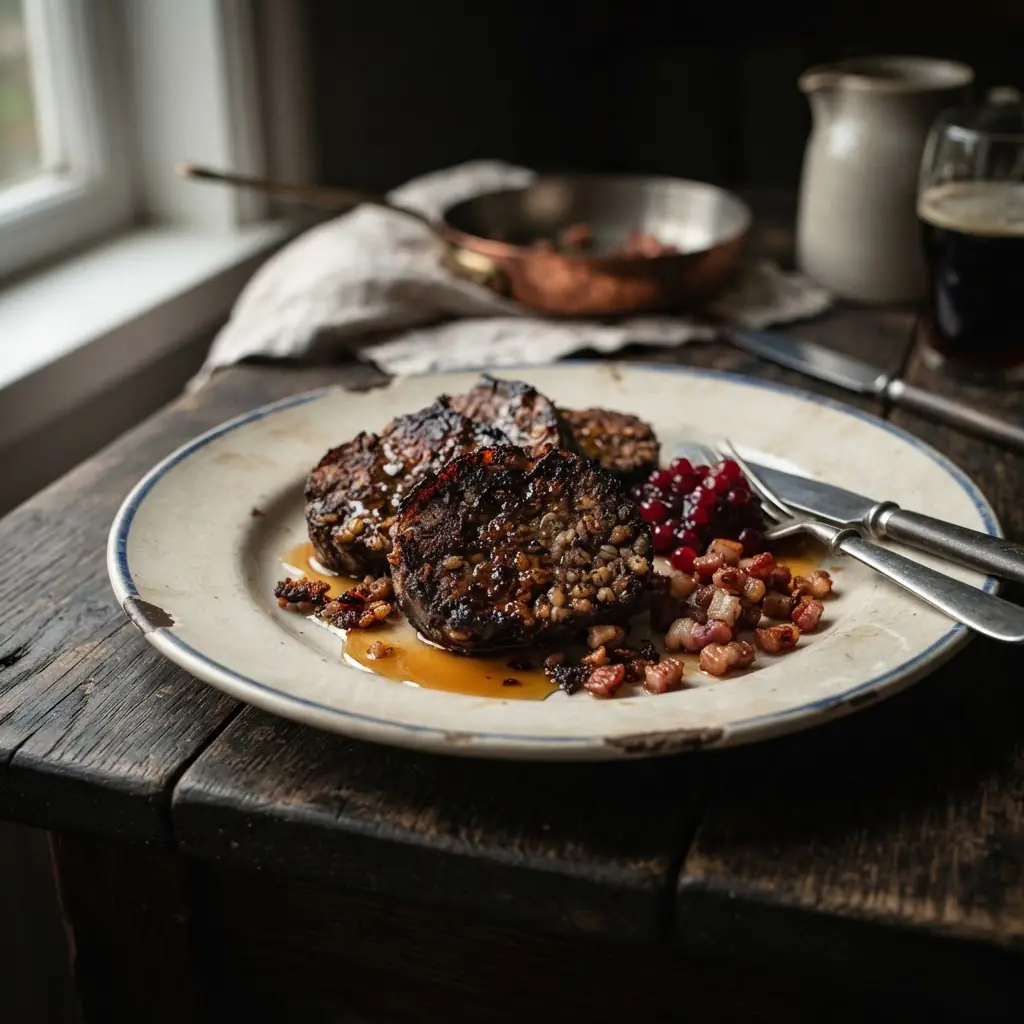
Blodklubb
Dense barley-and-blood dumplings, sliced and pan-fried in butter, served with syrup or bacon.
Cultural Context & History
A frugal winter dish born of nothing wasted, blood dumplings turn the harvest into a compact, iron-rich staple. Sliced and fried the next day, they are humble northern comfort.
Ingredients
- 500 ml fresh beef or pork blood
- 200 g ground suet (beef or pork fat)
- 300 g barley flour367 kcal · 10 g protein · 1.7 g fat · 80 g carbs per 100 g
- 100 g wheat flour467 kcal · 6.7 g protein · 20 g fat · 66.7 g carbs per 100 g
- 1 tsp salt, 1/2 tsp ground allspice0 kcal · 0 g protein · 0 g fat · 1330 g carbs per 100 g
- 1 litre beef broth4 kcal · 0.8 g protein · 0 g fat · 0.4 g carbs per 100 g
- For serving: fried bacon, golden syrup or sugar
Per-100 g values shown for ingredients verified against Nutrition data: USDA FoodData Central (snapshot 2026-09-11). Ingredients not yet verified show no nutrition line.
Recommended Tools
- Fine-mesh sieveCatches clots so the dough stays smooth.
- Deep stockpotHolds enough broth to poach the klubber gently.
- Slotted spoonLowers and lifts the dumplings without breaking them.
Product suggestions are editorial references only; no purchase or affiliate links are currently configured.
Step-by-Step Instructions
- 1
Strain the blood into a large bowl to catch any clots.
- 2
Work in the ground suet, salt and allspice, then add the barley and wheat flours a little at a time until you have a thick, sticky dough.
- 3
With wet hands, shape the dough into fist-sized balls — the klubber.
- 4
Bring the beef broth to a gentle boil and lower the dumplings in carefully.
- 5
Simmer gently for 45–60 minutes, until they float and are cooked through.
- 6
Slice and serve hot with fried bacon and a drizzle of golden syrup.
Chef's Tip
Test-poach a single klubb first: if it slumps or clouds the broth, work a little more barley flour into the dough before shaping the rest.
Chef's Tip
Leftover klubber are even better the next day — slice thick and fry in butter until the edges crisp and caramelise, then serve with a drizzle of syrup.
How this page was made
- Written by
- The Norcook editorial archive. No individual author is named yet — see the editorial and food-safety policy for what that means and what has to happen before a byline appears.
- Content last checked
- — “checked” records an editorial check, not a qualified review. Where one exists, the recipe-specific review record appears in the food-safety callout.
- Regional context
- Sápmi — the hub carries the wider background, the ingredient glossary and its own sources.
- Sources
- No page-level sources are recorded for this recipe yet. The cultural background above is written as general context, not as a sourced historical claim.
Keep exploring
There are 76 more stories waiting in the index — from Arctic cures to viral bakes.
Browse all recipes