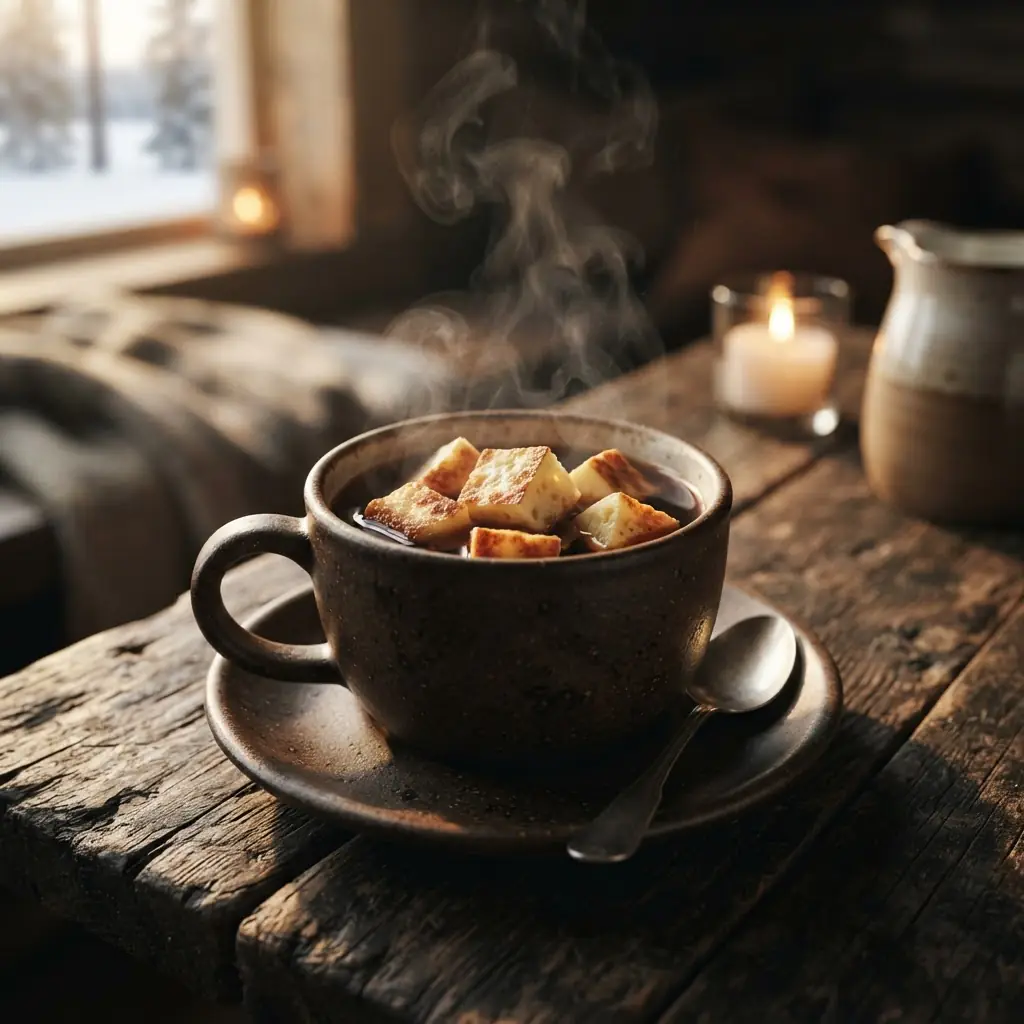
Kaffeost
Squeaky cubes of baked cheese dropped into strong, hot coffee — the north's beloved warming ritual.
Cultural Context & History
A tradition shared across the northern Sami and Kven communities, kaffeost drops firm curd cheese into hot coffee, where it softens and squeaks. Equal parts drink and snack, it is hospitality in a cup.
Ingredients
- 2 litres whole milk62 kcal · 3.3 g protein · 3.3 g fat · 5 g carbs per 100 g
- 100 ml heavy cream400 kcal · 0 g protein · 40 g fat · 6.7 g carbs per 100 g
- 2 tsp rennet (osteløpe)
- 1/2 tsp salt0 kcal · 0 g protein · 0 g fat · 1330 g carbs per 100 g
- Hot black coffee, to serve
Per-100 g values shown for ingredients verified against Nutrition data: USDA FoodData Central (snapshot 2026-09-11). Ingredients not yet verified show no nutrition line.
Recommended Tools
- Cooking thermometerHits the exact 37°C the rennet needs to set.
- CheeseclothDrains the curd into a clean, pressable disk.
- Heavy-based potWarms the milk gently without scorching the base.
Product suggestions are editorial references only; no purchase or affiliate links are currently configured.
Step-by-Step Instructions
- 1
Warm the milk and cream to 37°C in a large pot, then stir in the rennet and salt. Take off the heat and leave undisturbed for 40–50 minutes, until set to a soft curd.
- 2
Cut the curd into cubes and stir gently to release the whey. Tip into a cheesecloth-lined strainer and press lightly to drain into a flat disk.
- 3
Lay the disk in a baking dish and bake at 200°C for 15–20 minutes, until the surface is spotted brown.
- 4
Cool, cut into cubes, and drop into hot black coffee, where the cheese warms through and turns squeaky.
Chef's Tip
Drain the curd only until it just holds together — press out too much whey and the baked cheese turns rubbery rather than tender and squeaky.
Chef's Tip
The disk stores well: bake it ahead, keep it cool, and cube it into the coffee at the table so it softens without melting away.
How this page was made
- Written by
- The Norcook editorial archive. No individual author is named yet — see the editorial and food-safety policy for what that means and what has to happen before a byline appears.
- Content last checked
- — “checked” records an editorial check, not a qualified review. Where one exists, the recipe-specific review record appears in the food-safety callout.
- Regional context
- Sápmi — the hub carries the wider background, the ingredient glossary and its own sources.
- Sources
- No page-level sources are recorded for this recipe yet. The cultural background above is written as general context, not as a sourced historical claim.
Keep exploring
There are 76 more stories waiting in the index — from Arctic cures to viral bakes.
Browse all recipes