Kanelsnurrer
| Detail | Plan |
|---|---|
| Active work | About 50 minutes |
| First rise | 60–90 minutes, guided by expansion |
| Second rise | 30–45 minutes |
| Technique | Folded filling; strip twisting; secure underside |
| Make ahead | Bake, cool completely, and freeze |
Quantities live in the recipe card.
The soft dough
Milk supplies moisture for a flexible strip that can hold a knot.
The filling
An even thin layer gives cinnamon to every folded band.
The glaze
A light egg coat gives the exposed dough a glossy finish.
Doneness & Quality Checkpoints
- Dough stretches thinly before shaping and has visibly expanded during its first rise.
- The folded sheet holds an even layer of filling from center to corner.
- Knots retain their underside tuck through proofing and baking.
- A light press after proofing returns slowly; the dough is soft rather than tightly elastic.
- Golden tops and colored bases accompany a fully set central fold.
Kanelsnurrer
Prep: 50 minutes, plus 1½–2 hours rising · Cook: 20–24 minutes for two trays · Total: About 3–3¾ hours, including brief cooling · Makes 12 knots
Ingredients
The soft dough
- 500 g (about 4 cups) white wheat flour, plus up to 15 g (2 tablespoons) for rolling
- 75 g (⅓ cup plus 1 tablespoon) granulated sugar
- 2 g (1 teaspoon) ground cardamom
- 3 g (½ teaspoon) fine salt
- 7 g (2¼ teaspoons) instant dry baking yeast
- 75 g (5 tablespoons plus 1 teaspoon) unsalted butter
- 300 ml (1¼ cups) whole milk
The filling
- 75 g (5 tablespoons plus 1 teaspoon) unsalted butter, softened
- 50 g (4 tablespoons) granulated sugar
- 12 g (2 tablespoons) ground cinnamon
The glaze
- 50 g (1 large) egg without shell, beaten
Instructions
- Cool the melted butter before mixing. Melt the dough butter over low heat for 1–2 minutes and remove from the burner. Stir in the milk over 1 minute. Let the mixture stand for 5–10 minutes if necessary until only mildly warm; check 26–30 °C (79–86 °F). Mixing cool milk into the butter reduces its temperature, but still measure if it began very hot. Do not pour a hot fat-and-milk mixture over yeast. Checkpoint — The milk mixture is fluid and mildly warm, without a hot rim on the saucepan.
- Knead for stretch. Combine flour, sugar, cardamom, salt, and instant yeast. Pour in the milk mixture and stir 2–3 minutes until the flour is wet. Knead at low to medium-low speed for 10–12 minutes, or by hand for 12–15 minutes. The dough should become smooth and softly elastic as gluten develops. Lift a small piece and stretch it gently; it should form a thin translucent patch before breaking. Rest 5 minutes and knead 2–3 minutes more if it tears immediately. Checkpoint — Dough is supple and slightly tacky, with enough stretch to be rolled thinly without breaking.
- Let the dough expand. Cover in the mixing bowl and leave at room temperature for 60–90 minutes. Begin checking at 60 minutes and extend in 15-minute intervals if necessary. It should approach twice its original volume and feel light when handled. Meanwhile stir filling butter, sugar, and cinnamon for 1–2 minutes into a uniform paste. Keep the paste at cool room temperature, where it spreads without dripping. Checkpoint — The dough is visibly aerated, and the filling holds a soft spoon mark rather than separating into oily liquid.
- Fold an even rectangle. Dust the bench with only enough reserved flour to prevent sticking. Press the dough gently, then roll to approximately 48 × 30 cm (19 × 12 inches). Spread filling over the full surface in a thin layer, including the corners. Lift one long edge to meet the other, producing a rectangle approximately 48 × 15 cm (19 × 6 inches). Press lightly to settle the layers. Mark twelve strips across the long dimension, each about 4 cm (1½ inches) wide, and cut straight through both layers. Checkpoint — The folded sheet has even thickness and twelve consistent strips with filling enclosed between two dough faces.
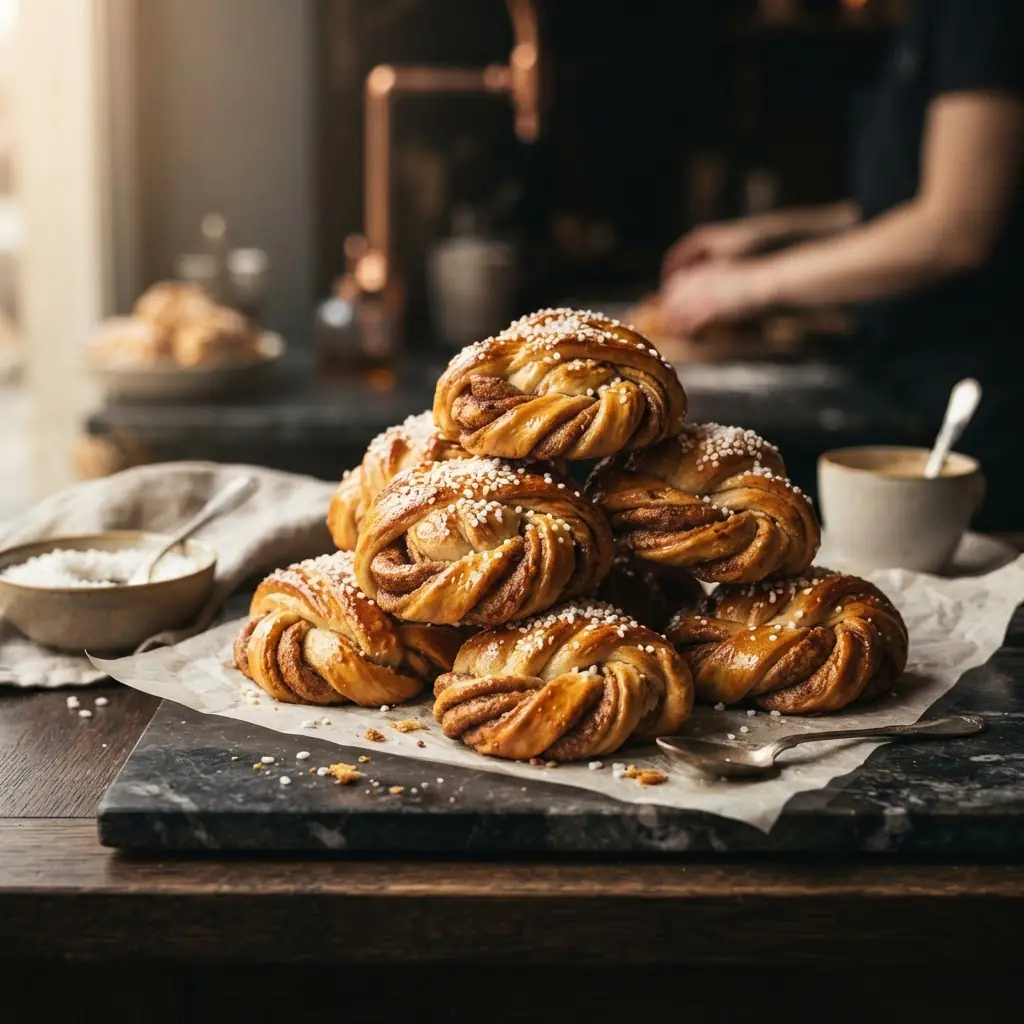
- Twist and secure each knot. Take a strip and gently lengthen it to around 22–25 cm (9–10 inches) if it stretches easily. Give it two or three loose twists. Drape one end across two fingers held together, wrap the strip around them, then lift the loop off your fingers and tuck the remaining end through the middle and underneath. Work over 10–15 minutes for the batch. Put six knots on each tray with at least 5 cm (2 inches) between them, placing the tucked tail against the paper. Checkpoint — Each knot has visible bands and an anchored underside; the dough does not split or squeeze out pools of filling.
- Proof and brush. Cover loosely for 30–45 minutes. Preheat the oven to 225 °C (435 °F) during the final 20 minutes. Test an unfilled outer patch gently: it should return slowly after a light press, leaving a slight indentation. Give tightly springing knots another 10 minutes. Brush beaten egg thinly over the exposed dough for 1–2 minutes, keeping the brush from dragging across delicate filling seams. Checkpoint — The knots look fuller and feel pillowy, while their cinnamon bands remain recognizable.
- Bake through the central fold. Bake one tray for 10–12 minutes, beginning checks at 10 minutes. The dough should be golden and glossy, with a lightly browned underside. Open a representative knot if uncertain: its center should show cooked, springy crumb instead of sticky flour paste. Extend 2–3 minutes as needed, shielding dark tops loosely with foil. Bake the second tray in the same way. Cool on a rack for 15–20 minutes. **Safety —** keep raw dough and egg glaze away from ready-to-eat food; do not sample either before baking. Checkpoint — The center is tender and set, with distinct cinnamon bands and no scorched butter smell.
Finish & Plate
Place the cooled warm knots on a plain serving board or small plates. Their twisted bands supply the finish; no sugar coating is needed for this formula. Break one through its thickest fold to check the crumb before bringing out the tray. Serve with coffee, tea, or a glass of milk. Keep cooling knots spaced on the rack so warm vapor can escape, and move them to a basket only when they will be eaten promptly. The best bite combines a soft middle with a lightly crisp cinnamon edge.
Troubleshooting
| Symptom | Cause | Fix |
|---|---|---|
| Strips tear while twisting | Dough insufficiently kneaded or pulled too firmly | Rest the strips 5 minutes and handle gently; improve the stretch test next time. |
| Knots unwind | Tail left on top or loosely attached | Tuck the end through and underneath so the tray anchors it during rising. |
| Filling runs out | Soft butter overheated | Keep the bench cool; chill an oily folded sheet briefly before cutting. |
| Center gummy | Large uneven knots or short bake | Test the thickest fold and extend baking with tops shielded as needed. |
Storage, Make-Ahead & Variations
Cool completely before sealing. Keep airtight at room temperature for 1–2 days, or freeze individually for up to 2 months. Thaw wrapped, then warm at 150 °C (300 °F) for 6–8 minutes. A loose foil cover protects dark tops. Halve the formula by weight for six knots, retaining the rectangle's thickness and the same final bun size. Brown sugar may replace the filling sugar at the same weight for a deeper flavor; its texture differs, so stir it thoroughly with the butter. Fresh yeast requires a deliberate conversion and its own mixing instructions, rather than substitution packet for packet. If shaping several trays for a larger batch, keep waiting dough covered and cool enough that its butter remains in place. These knots are best on baking day; freezing cooled extras preserves softness better than keeping them uncovered overnight.