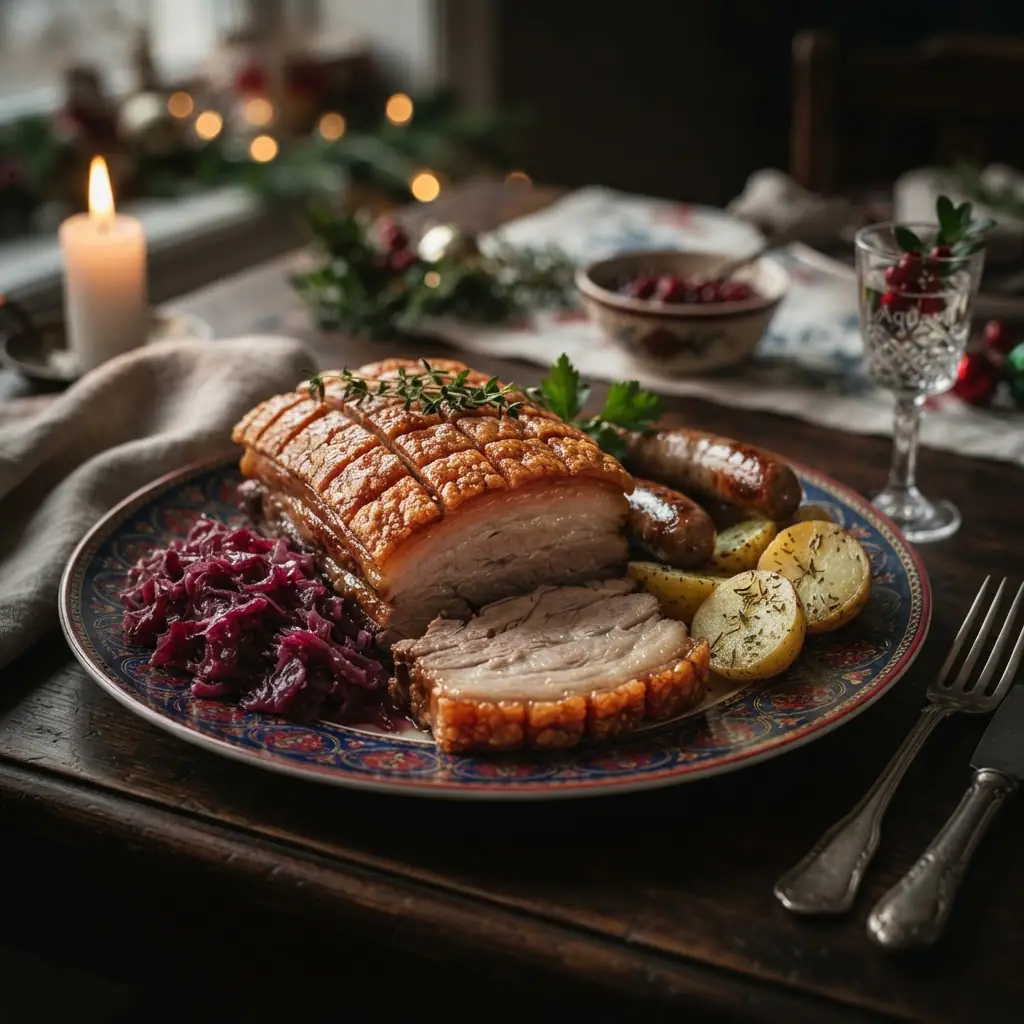
Ribbe
Slow-roast pork belly with shatteringly crisp crackling — the great Christmas Eve roast of the east.
Cultural Context & History
For most eastern Norwegian families, Christmas simply is ribbe — a scored slab of pork belly roasted until the rind blisters into glassy crackling. The pursuit of perfect svor is a national obsession.
Ingredients
- 2 kg pork belly ribs, rind on, bone-in
- 3 tsp salt0 kcal · 0 g protein · 0 g fat · 1330 g carbs per 100 g
- 2 tsp black pepper0 kcal · 0 g protein · 0 g fat · 167 g carbs per 100 g
- 200 ml water42 kcal · 0 g protein · 0 g fat · 10.8 g carbs per 100 g
Per-100 g values shown for ingredients verified against Nutrition data: USDA FoodData Central (snapshot 2026-09-11). Ingredients not yet verified show no nutrition line.
Recommended Tools
- Sharp scoring knifeCuts clean, even squares through the rind for reliable crackling.
- Deep roasting tinHolds the shallow water bath that steams and puffs the rind.
- Meat thermometerReads the core temperature so the meat is cooked through before the final blast of heat.
Product suggestions are editorial references only; no purchase or affiliate links are currently configured.
Step-by-Step Instructions
- 1
Score the rind into small squares with a very sharp knife, cutting cleanly through the skin but not into the meat. Rub salt and pepper into the rind and flesh two to three days before cooking, then refrigerate.
- 2
Sit the ribs rind-side down in a roasting tin, pour in the water, and cover the tin tightly with foil. Steam at 230°C for 45 minutes to puff and open up the rind.
- 3
Turn the ribs rind-side up and prop an inverted saucer or a ball of foil beneath the centre, so the tin tilts gently and the fat can run off.
- 4
Lower the oven to 200°C and roast, uncovered, for one and a half to two hours until the meat is tender.
- 5
Raise the heat again for the final minutes to blister the rind into crisp, even crackling — the sprø svor that makes the dish.
Chef's Tip
Leave the salted belly uncovered in the fridge for those two to three days; a dry rind is the single thing that separates crisp crackling from leathery skin.
Chef's Tip
If patches stay pale at the end, slide the tin under a hot grill for a minute or two, watching constantly so the squares blister rather than scorch.
How this page was made
- Written by
- The Norcook editorial archive. No individual author is named yet — see the editorial and food-safety policy for what that means and what has to happen before a byline appears.
- Content last checked
- — “checked” records an editorial check, not a qualified review. Where one exists, the recipe-specific review record appears in the food-safety callout.
- Regional context
- Østlandet — the hub carries the wider background, the ingredient glossary and its own sources.
- Sources
- No page-level sources are recorded for this recipe yet. The cultural background above is written as general context, not as a sourced historical claim.
Keep exploring
There are 76 more stories waiting in the index — from Arctic cures to viral bakes.
Browse all recipes